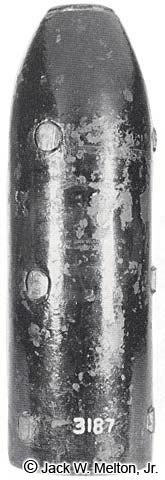
English 3-inch Confederate Imported Armstrong Shell
This Extremely Rare studded Armstrong shell was buried by the Confederates during their retreat in 1865. It was recovered around twenty years ago by Chester Dawson (now deceased) in Amelia County, Virginia. A total of seven unfired Armstrong shells, long and short pattern types, were found by Chester. The fuzes were found in a separate hole by Tony Easter. The shells were recovered near were the Battle of Painsville occurred. 1/4 mile up the hill from where they were found is the Pains Crossroads. In General Henry Abbot's collection, now housed in the United States Military Academy Museum in West Point, NY, is a similar specimen recovered from the Richmond area by Abbot's men in 1865.| Click on any image to enlarge the photograph | ||
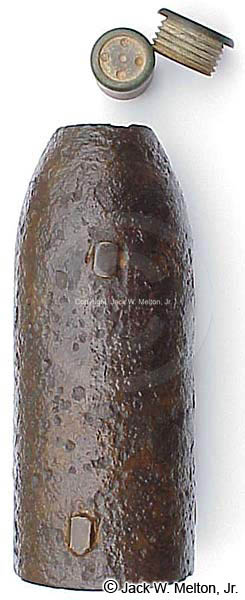 3-inch, 12-pounder Armstrong Shell |
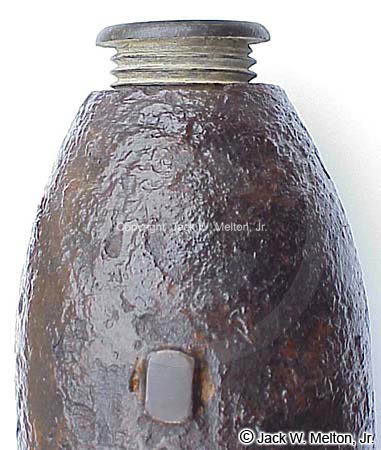 |
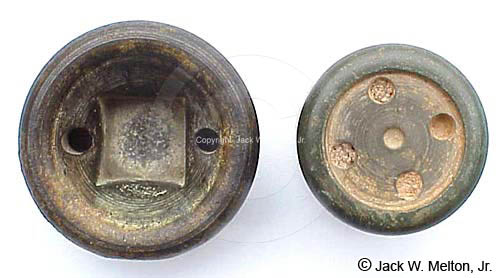 Unusual in that the shipping plug was converted to allow for the flame to light the fuze. 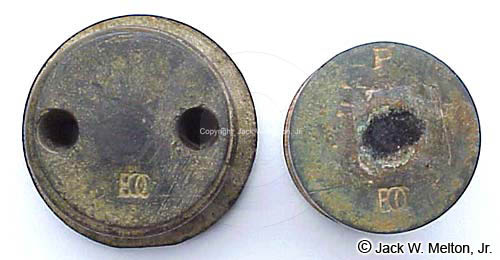 Fuze with the British Marks. |
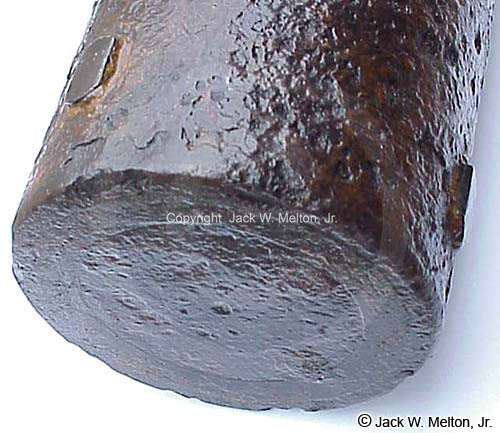 Base showing the inner band. |
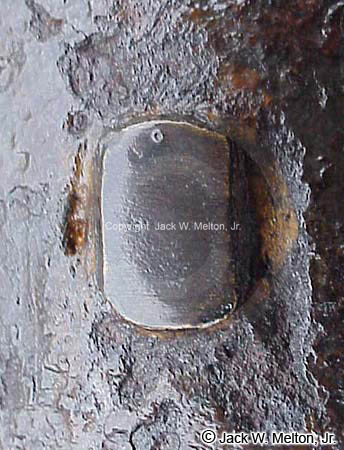 Close up of the copper stud. |
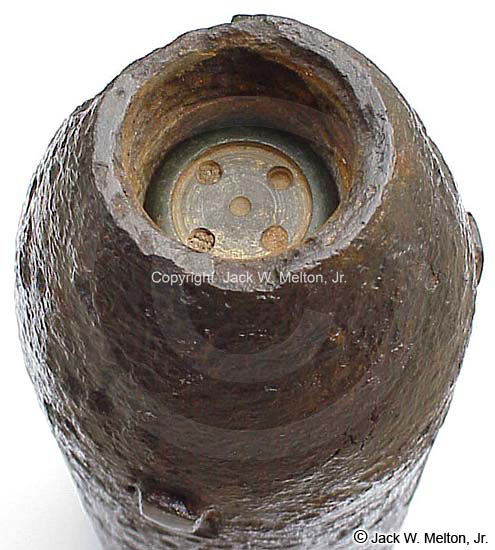 |
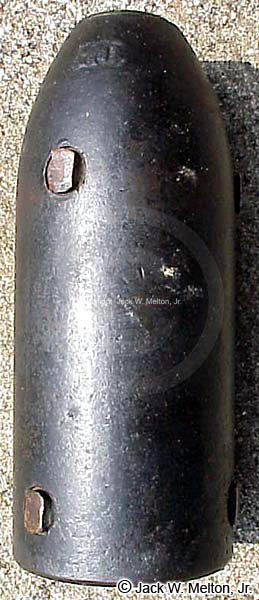 Non-dug example for comparison. |
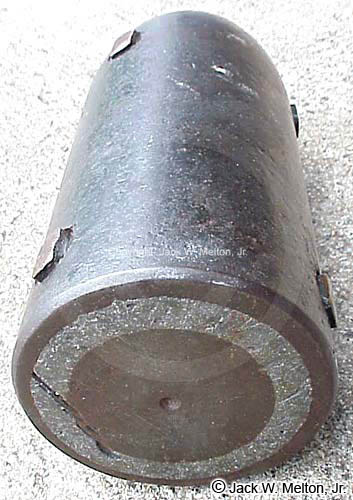 Non-dug example for comparison. |
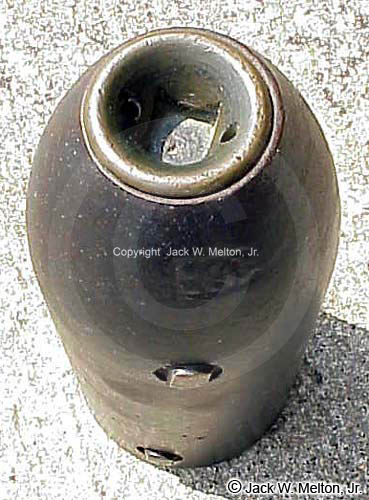 Non-dug example for comparison. |
Armstrong Cannon information from the Army Official Records
relating to the above excavated projectile.
80 R R--VOL XLVI, PT II
PAGE 1266-96 N. AND SE. VA., W. VA., MD., AND PA. [CHAP. LVIII.
[Series I. Vol. 46. Part II, Correspondence, Etc. Serial No. 96.]
SPECIAL ORDERS, No. 55. HDQRS. DEPT. OF NORTHERN VIRGINIA,
February 28, 1865.
assigned to the command of Rodes' old division, Second Corps, and
will report accordingly.
By command of Gen. R. E. Lee:
W. H. TAYLOR,
Assistant Adjutant-Gen.
HDQRS. ARTILLERY, FIRST CORPS,
February 28, 1865.
[Gen. PENDLETON: ]
GEN.: I
received this morning your note directing me to turn over
four 3-inch rifles to the cavalry; but while making arrangements to
execute it, I beg to submit that it will seriously weaken my rifle
armament, already, I believe, the weakest in the army. The
10-pounder
Parrotts in my command I have condemned entirely, and have made
arrangements with the Ordnance Department to exchange them all for
24-pounder howitzers, having found it impossible to get
satisfactory
firing from them, and I hope to be rid of every one when we take
the
field. I have only six now, including two in Hardaway's battalion;
this
will leave with sixty-four smooth-bores, eighteen 3-inch rifles,
and five
Armstrong and one Whitworth in
Cabell's, Huger's, Haskell's,
Hardaway's, Stark's and Johnson's battalions the Armstrong
and
Whitworth are only temporary guns, as the ammunition for the former
is limited, and when it is gone I wish to replace them all with
smooth-bores, which will give seventy smooth-bores and eighteen
rifles
a proportion of rifles which I think you will agree with me is too
small
to be diminished. Should Owen's battalion return in place of any
other
it will diminish the proportion of rifles, as it has none, and
should
Hardaway rejoin his corps he will take away six of the eighteen
3-inch.
Many of my smooth-bores will also be howitzers of less range than
Napoleons. I do not like any rifle with our ammunition, but must
have some.
best gun for their service, and would prefer them to anything were
I in
that arm. Our 3-inch have no shrapnel; their shell very defective
and
uncertain, even when they explode at all, and you know the frequent
complaint on this head and their canister is very small and
inferior. The
Yankees have shrapnel and canister with lead balls, and thus use
them
very efficiently, but our 3-inch are not their 3-inch by a great
deal. The
12-pounder howitzer is
lighter, its ammunition cheaper and more
abundant; it formidable shrapnel; its shell seldom ever fails, and
its
canister is but little inferior to that of Napoleons. Where guns
have to
protect themselves against a charge of either infantry or cavalry,
I
believe the 12-pounder howitzer
superior to the Napoleon and worth
twice its number of 3-inch rifles. Is not this gun better adapter
to the
service of cavalry than a gun whose only recommendation its has a
very
long range and one-half of whose
projectiles never burst (and when one
does burst it does not make a dozen fragments), and which is very
dangerous to our own men when fired over their heads? I have entire
forbidden their use by my battalions over our infantry.
N. AND SE. VA., W. VA., MD., AND PA. [CHAP. LVIII. PAGE 1267-96
[Series I. Vol. 46. Part II, Correspondence, Etc. Serial No. 96.]
I have sent in
to Col. Brown to know what he can give me to replace
the 3-inch, if you still desire the
exchange. I don't want Parrotts (would
rather have mountain howitzers,) and prefer 12-pounder howitzers to
Napoleons, of which I have enough. It will also be dangerous to
take
my guns from the lines while awaiting even the unavoidable and
especially the probable delay.
Cannot the
horse artillery be ordered to provide themselves with
12-pounder howitzers, and report to me to be directed where to
exchange them for 3-inch rifles? Please reply to me by telegraph,
care
of Gen. Longstreet, if you wish the exchange to go on as you have
directed in you note.
Very respectfully, yours,
E. P.
ALEXANDER,
Brig.-Gen. of Artillery.
HDQRS. ARMY OF THE POTOMAC, ORDNANCE OFFICE,
May 31, 1865.
Col. GEORGE D. RUGGLES,
Assistant Adjutant-Gen.:
SIR: I have
the honor to make the following report of artillery and
small-arms received by the ordnance department, captured from and
surrendered by the enemy in the recent campaign, in operations
around
Petersburg, and against the rebel army after the evacuation. This
does
not include the heavy artillery which was collected by Gen. Abbot
and not received by any of the ordnance officers of this army:
Light
12-pounder bronze guns, U.S., 70; light 12-pounder bronze guns,
rebel,
62; 12-pounder cast-iron guns, banded, rebel 34; 3-inch
wrought-iron
PAGE 1242-97 N. AND SE. VA., W. VA., MD., AND PA. [CHAP. LVIII.
[Series I. Vol. 46. Part III, Correspondence, Etc. Serial No. 97.]
guns, U.S. 33;
3-inch wrought-iron guns, banded, rebel, 13;
10-pounder Parrott guns, U. S., 10; 20-pounder Parrott guns, U.S.,
2; Coehorn mortars, rebel, 1; 3-inch Whitworth guns, rebel, 1;
12-pounder howitzers, U. S., 5;
12-pounder howitzers, rebel, 3;
3.4-inch Blakely guns, 1; 3.67-inch rebel guns, banded, 1;
3.80-inch
smooth-bore guns, 2; 24-pounder howitzers, U. S., 4; 24-pounder
howitzers, rebel, 2; 24-pounder howitzers, U. S., Dahlgren, Navy,
1;
12-pounder Armstrong
guns, rifled, rebel, 5; 12-pounder iron guns,
re-enforced, rebel, 1. Total number, 251. Rifles and muskets,
21,177;
carbines, 1,293; pistols, 163. Total number small-arms, 22,633.*
Very respectfully, your obedient servant,
F. H. PARKER,
Lieut. and Chief Ordnance Officer, Army of the Potomac.
PAGE 72-95 N. AND SE. VA., N. C., W. VA., MD., AND PA. [CHAP. LVIII.
[Series I. Vol. 46. Part I, Reports. Serial No. 95.]
No. 4.
Itineraries of the Army of the Potomac, Sheridan's Cavalry
Command, and the Army of the James.* cont…
Reports from the Third Brigade, Third Division.
CHAP. LVIII.] THE RICHMOND CAMPAIGN. PAGE 85-95
[Series I. Vol. 46. Part I, Reports. Serial No. 95.]
[March.]--Remained in camp near Hatcher's Run, participating in the
affair of
March 25 near the Tucker house, where, after a stubborn
resistance on the part of the enemy, we succeeded in taking and
retaking the enemy's picket-line in our front.
March
29.--Broke camp, and moved with the rest of the division to the
left near the Boydton plank road.
March
31.--Made a gallant charge on the enemy's works to develop
their strength.
April
2.--Attacked and captured the enemy's picket-line where the
Boydton plank road crosses the White Oak road, and afterward
occupied his main works and advanced to Petersburg.
April 3 to 5.--Pursued the enemy.
April
6.--Came up with him at Amelia Springs.
Skirmished with him all
day, and at night succeeded in forcing him to abandon
his wagon train.