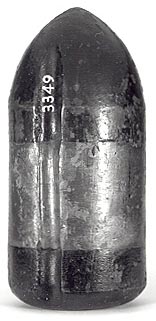
Several
Hotchkiss projectiles exactly like this pattern have been recovered from
the West Point Proving Grounds, West Point, New York. To date, this
pattern hasn't been recovered from any Civil War battlefields. One
specimen was recovered from a house site near Belvedere Cove around
1890. The unfired example pictured resides in the West Point
Military Academy Museum. There are three components that make up
this projectile's construction: a nose section, lead ring or band
around the center, and a base cup that, when fired, would force the lead
sabot into the grooves of the cannon's rifling. The base is flat and
there are three flame grooves. Most likely this pattern was
manufactured at the end or after the Civil War and wasn't intended for
field artillery due to it's caliber.