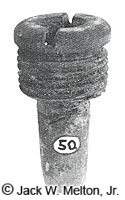
Complete brass
Hotchkiss time fuze plug
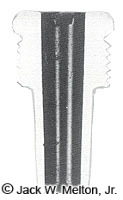
Cross-section of the brass
Hotchkiss time fuze plug
The Hotchkiss fuze plug is made of brass and has a screwdriver slot across
the face. The plug is threaded and was screwed into the fuze well of the
projectile. A paper time fuze, composed of a powder composition tightly wrapped in
paper, was then driven into the center of the plug. The length of the
fuze
determined the amount of time it took to finish burning. The artillerist could
either choose a manufactured fuze or alter the length of a fuze so that it would burn for
a shorter period of time. Then the fuze burned through to the end, the flame was
transmitted through the hole in the fuze plug and into the powder chamber of the
projectile. This is a representative example of this class of time fuzes.
Parrott Percussion
Fuze
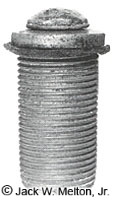
Complete Parrott Percussion fuze
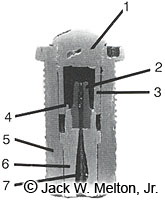
Cross-section of the
Parrott zinc percussion fuze
This type of Parrott percussion fuze saw extensive use. The
fuze
body (5) is made of zinc and was screwed into the fuze hole by a spanner wrench using the
two spanner holes at the top of the fuze. An anvil (1) is screwed into the top
center of the fuze. The interior contains a percussion cap (placed where 2
points; missing from this cutaway) seated on a nipple, the plunger or striker (6), and the
powder train (7). The striker is held back by two small projections (4) on a safety
pin (3). When the fuze impacted, the two projections broke and allowed the striker
to move forward. The percussion cap struck the anvil and exploded, sending a flame
through the nipple to the powder train. The flame was then transferred to the powder
chamber of the projectile. This is a representative example of the class of
percussion fuzes.